HolyProd Film
A.I.F.O.S.

Film production tool

From script to finished film, on a single canvas.

A.I.F.O.S. is a nodal workstation for making films with generative AI. You write, break scenes into shots, build each shot, lay the voice and the music, then edit — without ever switching tools or copying a prompt from one window to the next.

A complete film has already been produced with it.

The production chain

Each stage feeds the next through a typed cable: a camera only connects where a camera makes sense. What was decided upstream travels down to the shot, with nothing retyped.

Scriptassisted writingBreakdownscene → shotsStoryboardshot cardsImagekeyframesVideofirst → last frameSoundvoice, musicEditfilm delivered

Showreel

Eight seconds: the workspace, the chain it runs, and shots that came out of it.

Promotional montage. The screenshots in the next section are untouched.

What comes out of it

Two excerpts made with the tool, from prompt to delivered image.

Commercial shot
Character sheet, visual bible

What it fixes

Prompts stop being retyped

The visual bible, a character sheet, the camera settings and the intent of the scene all plug into the shot. The prompt sent to the engine already carries them.

The breakdown becomes a draft you can watch

An approved scene goes out for analysis and comes back as shootable shots — framing, duration, intent, image and video prompts already written — then as rough images laid onto the cards. You watch the film before building it.

The client sees without getting in

A review link opens a portal showing only the published deliverables. The client comments and leaves a voice note; they reach neither the canvas nor any other project.

The application

Screenshots from a demonstration project — an animated short, from storyboard to delivered shots.
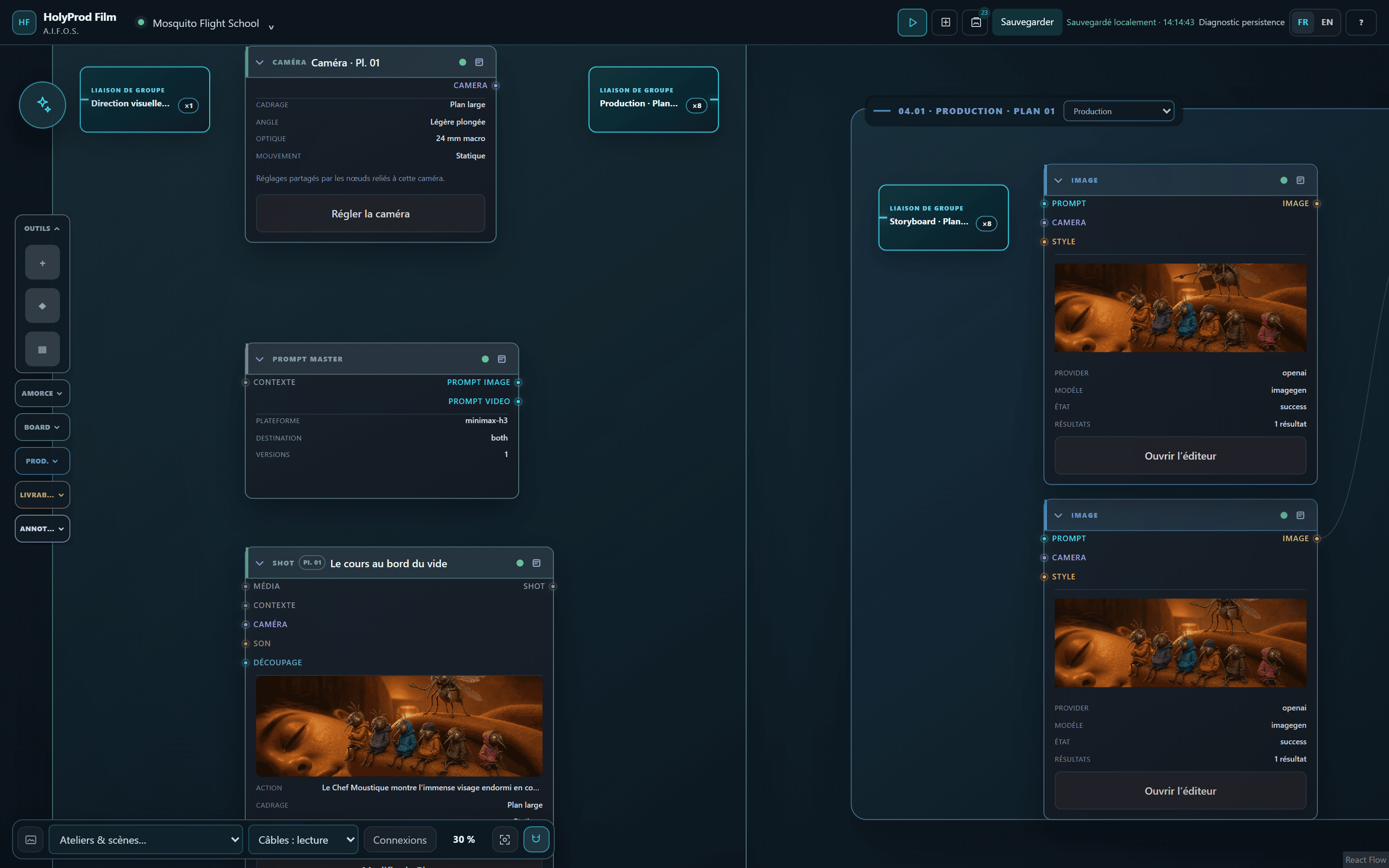
A storyboard shot wired to its camera, its Prompt Master and its generated images.
One shot, and everything that builds it — Every card carries typed sockets: media, context, camera, sound, breakdown. Camera settings are shared by every shot wired to it, and each image states the engine, the model and the state of its generation.
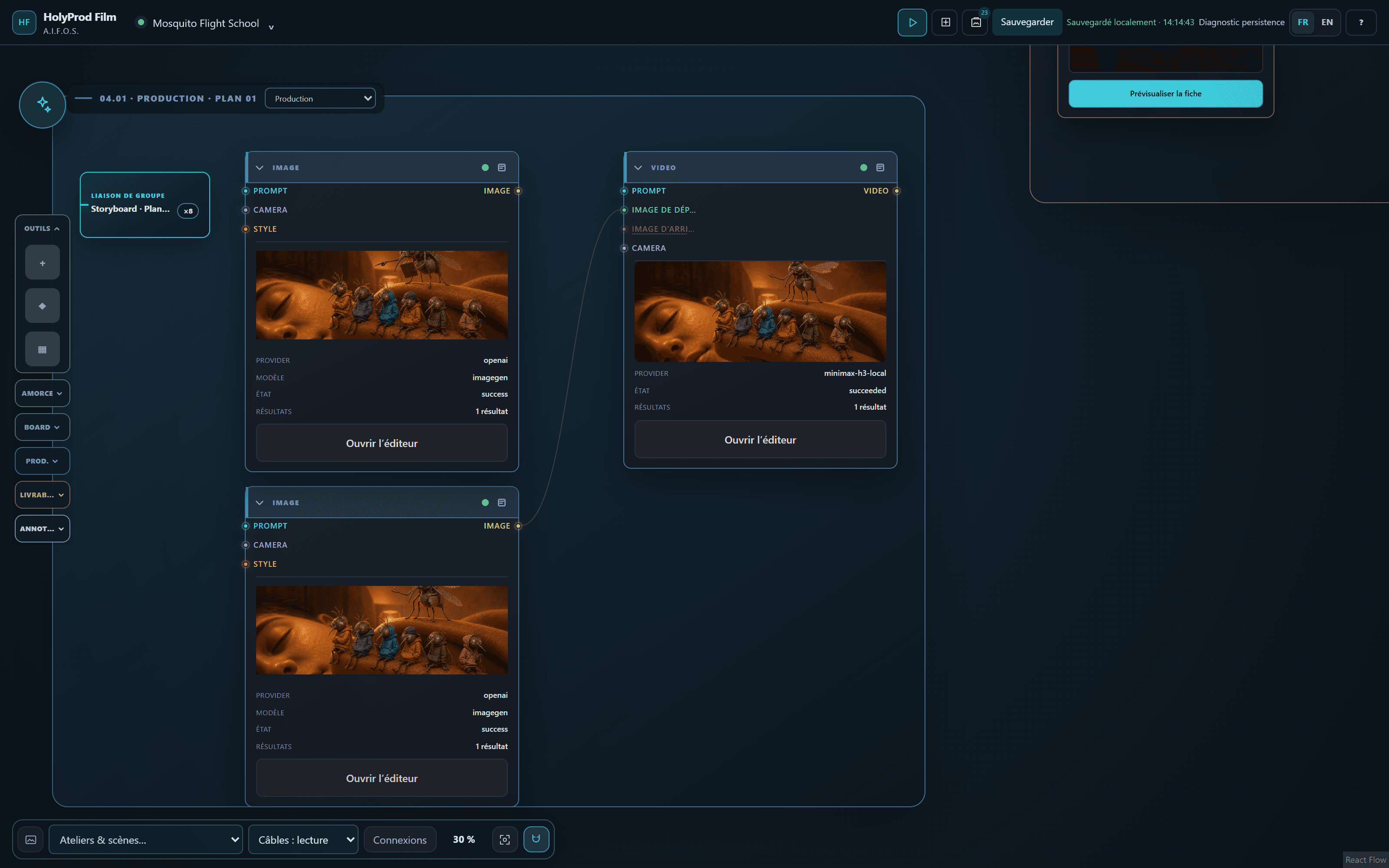
The Image and Video nodes of a shot, with their versions and settings.
From still frame to moving shot — A first frame and a last frame feed the Video node: the engine interpolates the motion between them. Every run creates a version — nothing is overwritten.
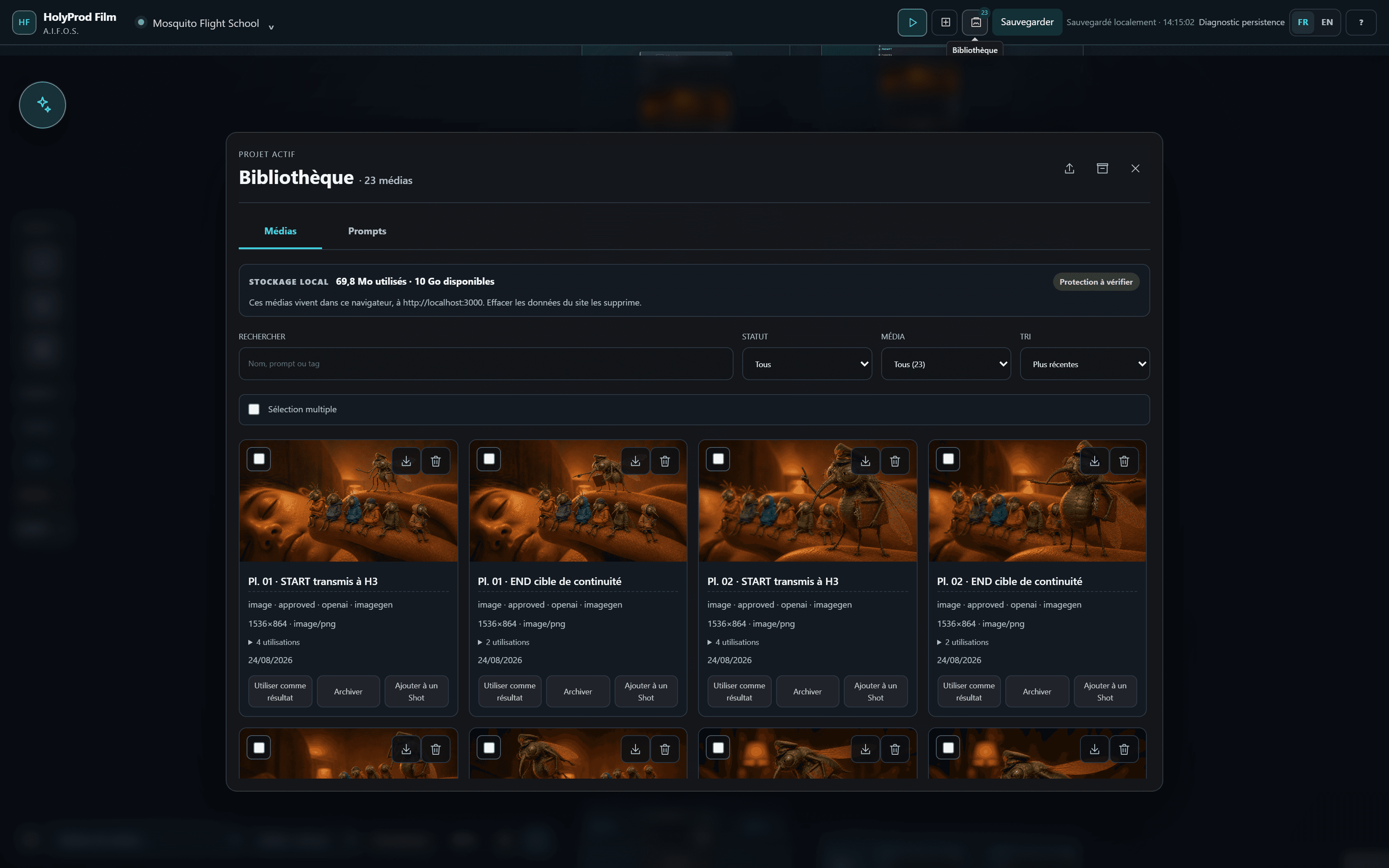
The project library: thumbnails, statuses, engines, sizes and usage.
A library that knows where every image came from — Prompt, engine, model, dimensions, approval status and how many times it is used in the film. Media lives with the user — the application never claims it.

How it is built

A production tool does not forgive approximation: a failed generation costs money, and a silent error costs a shooting day.

4,284automated tests
55server routes
10engines driven
566application modules
  • No key ever leaves the server.Every engine sits behind its own contract: the browser asks, the server calls. A key never appears in a page or in an error message.
  • No silent fallback between engines.If an engine refuses, the failure stays visible and attributed to its cause. Nothing quietly falls back to another model — you would read it on the delivered image.
  • The work stays with whoever does it.Projects and media live in the user's own space, exportable as a complete archive. The application is not a warehouse.
  • Every path is proven for real.An engine is only declared good once it has produced a real, stored, replayable asset — not once its tests pass.

Next.js 16 · React 19 · TypeScript strict · React Flow · Vitest & Playwright · OpenAI, Gemini, Anthropic, Perplexity, ElevenLabs, Higgsfield, MiniMax, InvokeAI, Ollama.